
When choosing sake, you may come across numbers such as +5 or −3 on bottle labels or in product descriptions. These numbers represent the Sake Meter Value (SMV), known in Japanese as Nihonshu-do.
SMV is one of the measurements used to describe the characteristics of sake, particularly its tendency toward sweetness or dryness. However, understanding what these numbers actually mean requires a closer look at the science behind them.
In this article, we’ll explore how SMV is determined, how it relates to acidity, and how both measurements influence the way we experience sake. We’ll also introduce specific sake examples and explain how this knowledge can help you make more informed choices when pairing sake with food.
1. What Is Sake Meter Value? Understanding the Basics of Sweet and Dry Sake
What Is Sake Meter Value?
Sake Meter Value (SMV), or Nihonshu-do (日本酒度), is a numerical measurement based on the specific gravity of sake. It is commonly used as an indicator of whether a sake is likely to taste sweet or dry.
Specific gravity is influenced by the components dissolved in sake, particularly sugar and alcohol. By measuring the density of sake, SMV provides a standardized reference for understanding certain characteristics of the finished product.
In the sake industry, SMV is widely used to describe and compare different sake. It may also appear on bottle labels or in product descriptions, making it a useful reference when choosing a sake that suits your preferences.
However, SMV is not a direct measurement of sweetness. Although positive values generally indicate drier sake and negative values tend to indicate sweeter sake, the actual taste is influenced by several other factors, including acidity.
To understand this relationship, let’s first look at how specific gravity works.
Understanding Specific Gravity
Specific gravity describes the density of a substance compared with that of a reference substance. For liquids, water is generally used as the reference.
Consider two containers, each holding one liter of liquid.
One contains plain water, while the other contains sugar water.
If we assign water a specific gravity of 1, the sugar water might have a specific gravity of 1.1 because dissolved sugar increases its density.
In other words, a liquid that is denser than water has a specific gravity greater than 1, while a liquid that is less dense than water has a specific gravity below 1.
Sugar and alcohol affect the density of a liquid in opposite ways.
Sugar increases density, making the liquid heavier for the same volume. Alcohol, on the other hand, is less dense than water and can lower the density of the liquid.
The balance between these components is particularly important when understanding the specific gravity of sake.
The Relationship Between Specific Gravity and SMV
Sake contains both sugar and alcohol, which influence its specific gravity in different ways.
During fermentation, yeast converts sugar into alcohol. As fermentation progresses, the sugar content generally decreases while the alcohol content increases.
As a result, the density of the fermenting liquid tends to decrease.
Sake containing relatively little residual sugar and more alcohol generally has a lower specific gravity, resulting in a positive (+) SMV.
Conversely, sake containing more residual sugar may have a higher specific gravity, resulting in a negative (−) SMV. Certain lower-alcohol sake can also have negative values because alcohol has less influence on reducing the liquid’s density.
This is the principle behind the Sake Meter Value.
Generally, the higher the positive number, the drier the sake tends to be. The more negative the number, the sweeter it tends to be.
The following table provides a general reference.
| Sake Meter Value | General Classification |
| +6.0 or higher | Very dry |
| +1.5 to +5.9 | Slightly dry |
| −1.4 to +1.4 | Neutral |
| −1.5 to −5.9 | Slightly sweet |
| −6.0 or lower | Very sweet |
These classifications are general guidelines rather than absolute definitions of taste.
SMV reflects the density of sake, not the exact sweetness perceived on the palate. Two sake with similar SMV values may taste quite different depending on their acidity and other components.
2. How Is Sake Meter Value Measured?
SMV is traditionally measured using a special hydrometer called a Nihonshu-do meter.
This instrument measures the specific gravity of sake by floating in the liquid. The standard measurement is taken at 15°C (59°F), as temperature affects liquid density and therefore the reading.
The measurement process involves four steps:
- Prepare the sake sample. Pour sake adjusted to 15°C into a tall measuring cylinder.
- Place the hydrometer in the sake. Gently lower the instrument into the liquid and allow it to float freely.
- Read the scale. Check the point where the surface of the liquid meets the scale on the hydrometer.
- Record the SMV. The reading gives the sake’s SMV, a numeral value derived from its specific gravity.
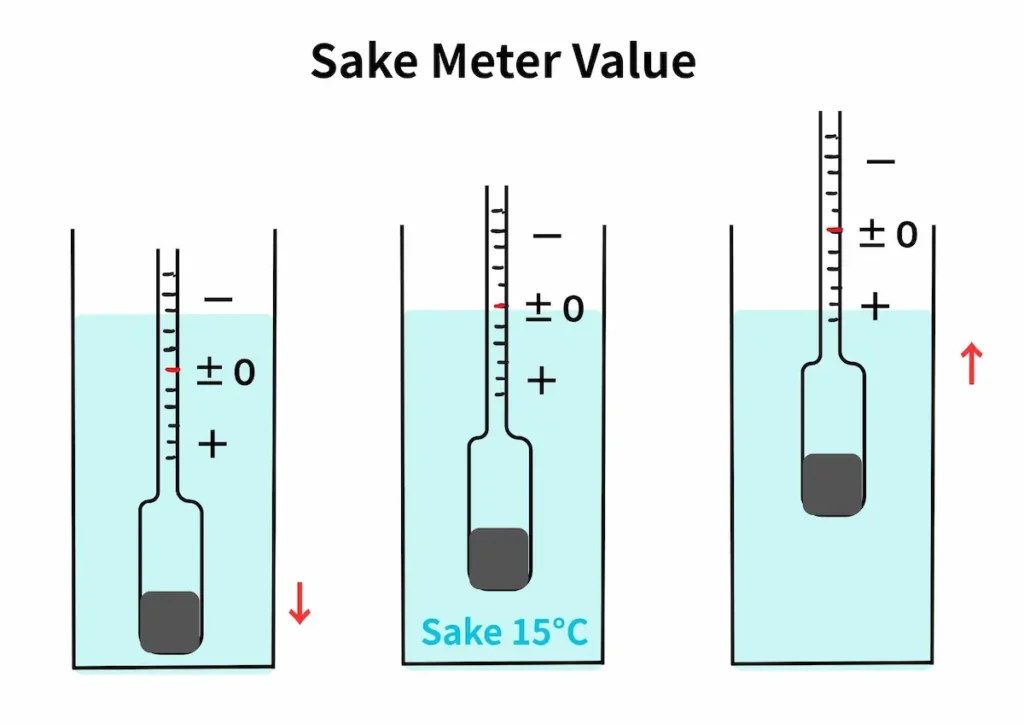
The position of the hydrometer changes according to the density of the sake.
As shown in the center illustration below, an SMV of 0 indicates that the sake has a specific gravity close to that of water under the standard measurement conditions.
In contrast, the illustration on the left shows that more negative values indicate higher specific gravity and a tendency toward sweetness. The illustration on the right shows that more positive values indicate lower specific gravity and a tendency toward dryness.
This method provides brewers with a standardized way to measure and compare sake.
However, while SMV provides useful information about the composition of sake, it cannot fully describe its flavor. To understand how sake actually tastes, we also need to consider acidity.
3. How Does Acidity Affect the Taste of Sake?
Understanding Acidity in Sake
The taste of sake is shaped by several elements, including sweetness, umami, bitterness, and acidity. Among these, acidity plays a particularly important role in determining its overall balance and character.
Unlike the strong sourness we might associate with lemon juice, acidity in sake is often more subtle. It comes primarily from organic acids produced during fermentation, which contribute to the sake’s balance, richness, and finish.
Four major organic acids—lactic acid, malic acid, succinic acid, and citric acid—account for a substantial proportion of the organic acids found in sake.
Each has its own characteristics, and differences in their types and concentrations contribute to the diversity of sake flavors.
Four Important Organic Acids in Sake
Lactic Acid — Softness and Depth
Lactic acid is one of the most abundant organic acids found in sake.
It contributes a gentle, rounded acidity, sometimes reminiscent of fermented foods such as yogurt and cheese.
Lactic acid also plays an essential role during sake brewing.
In the preparation of the yeast starter, known as shubo or moto, lactic acid helps suppress unwanted microorganisms and creates an environment in which yeast can ferment properly.
This function is particularly important in traditional brewing methods such as kimoto and yamahai, where lactic acid bacteria are involved in the development of acidity.
Malic Acid — Refreshing and Fruity Acidity
Malic acid is associated with the refreshing acidity found in fruits such as apples.
In sake, it can create a bright, fruity character, sometimes reminiscent of white wine.
This characteristic can become particularly noticeable when the sake is served chilled.
In recent years, some breweries have developed sake using yeast strains that produce higher levels of malic acid, resulting in refreshing, fruit-forward styles.
Succinic Acid — Umami and Richness
Succinic acid is one of the organic acids associated with the distinctive umami and richness of sake.
It contributes depth and body, giving sake a more substantial flavor.
It is found in relatively high amounts in some junmai sake and is also naturally present in shellfish such as clams, where it contributes to their savory taste.
Its relationship with umami makes it particularly interesting when considering sake and food pairing, especially with seafood and traditional Japanese dishes.
Citric Acid — Sharp and Refreshing
Citric acid is characterized by a bright, refreshing acidity similar to that found in citrus fruits.
It can contribute a crisp finish and help balance sweetness.
Although citric acid is generally less prominent in conventional sake, higher concentrations can be found in sake made using white koji.
These sake often have a distinctive sweet-and-sour character, demonstrating how different organic acids can influence the final taste.
How SMV and Acidity Influence Flavor
While SMV provides an indication of whether sake tends toward sweetness or dryness, acidity contributes to its structure, richness, and overall balance.
Acidity can make sweetness feel less pronounced while bringing greater definition to the flavor.
Sake with higher acidity often has a more clearly defined taste, with greater depth and a firmer finish. Sake with lower acidity generally feels softer and more delicate.
As a general guideline, an acidity level of approximately 1.4–1.6 is often used as a reference point.
| Acidity Level | General Taste Characteristics |
| 1.0 or below | Light, delicate, and gentle |
| Around 1.4–1.6 | Moderate acidity and balance |
| 2.0 or higher | More pronounced acidity, often with greater structure and intensity |
These values are only general references. The actual taste also depends on the types of organic acids present and how they interact with other flavor components.
The influence of acidity becomes particularly interesting when considered alongside SMV.
When SMV Indicates a Drier Sake
Low acidity
A dry sake with relatively low acidity often has a light, clean character.
- A smooth, delicate mouthfeel with a crisp finish
- Subtle flavors and a relatively light body
- An approachable style that pairs well with lightly seasoned dishes
High acidity
When a dry sake has higher acidity, its flavor may become more pronounced.
- A firmer, sharper taste with a refreshing finish
- Greater body, richness, and depth
- A more powerful dry style that can complement strongly flavored foods
When SMV Indicates a Sweeter Sake
Low acidity
A sweet sake with relatively low acidity tends to emphasize its sweetness.
- A gentle, rounded sweetness
- A soft, smooth mouthfeel
- A fuller impression because there is less acidity to balance the sweetness
High acidity
Higher acidity can create a refreshing balance in sweet sake.
- Acidity helps prevent the sweetness from becoming overwhelming
- A pleasant combination of sweetness and tartness
- A cleaner finish that makes even relatively sweet sake feel refreshing
These combinations demonstrate why SMV and acidity should not be considered separately.
A sake with a negative SMV may taste surprisingly refreshing when its acidity is high, while a sake with a positive SMV may feel soft and rounded when its acidity is low.
Understanding both measurements provides a more complete picture of the sake’s potential flavor characteristics.
4. Recommended Sake for Dry Sake Lovers: A High SMV Example
Shinkai Junmai Gekikaraguchi +20 Nama Genshu
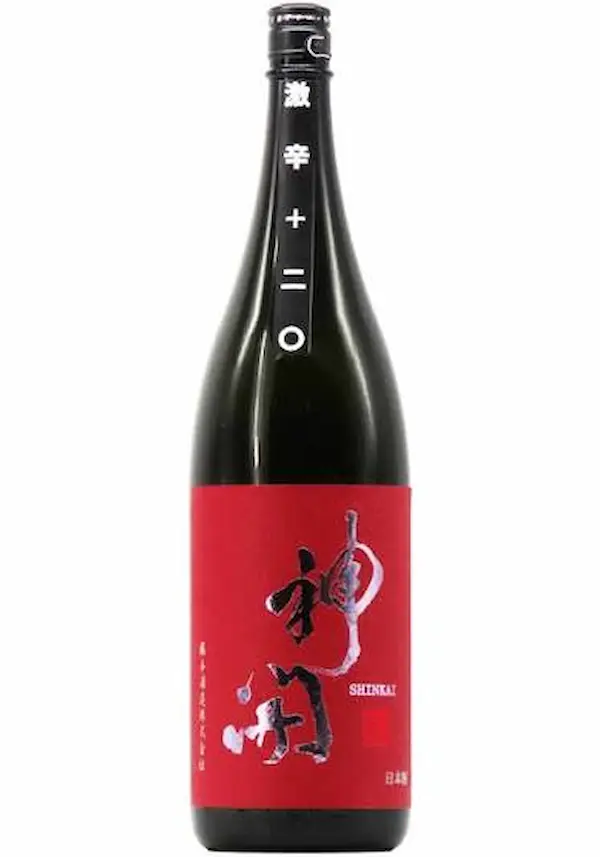
Brewery: Fujimoto Shuzo, Shiga Prefecture
| Specification | Details |
| Rice polishing ratio | 60% |
| Alcohol content | 19% |
| Sake Meter Value | +20 |
| Acidity | 1.7–1.8 |
Produced by Fujimoto Shuzo in Koka City, Shiga Prefecture, Shinkai Junmai Gekikaraguchi +20 Nama Genshu is an exceptionally dry junmai sake.
With an SMV of +20, it is a clear example of a sake in which fermentation has progressed extensively, resulting in relatively little residual sugar.
Its sharp, crisp character is supported by a slightly elevated acidity level of 1.7–1.8, which contributes structure and helps bring out the sake’s richness and umami.
The result is a powerful sake that balances pronounced dryness with depth of flavor.
Its relatively high alcohol content of 19% adds further body and intensity. However, despite its exceptionally dry classification, the sake also reveals the natural umami of rice and a subtle underlying sweetness.
This balance makes it more complex than its SMV alone might suggest.
Its crisp finish also makes it suitable for a wide range of food pairings, including sashimi, grilled fish, and meat dishes.
For those interested in understanding how a high SMV translates into actual flavor, this sake offers an excellent example.
5. Recommended Sake for Sweet Sake Lovers: A Rich Kijoshu Example
HIRAN Reborn Kijoshu (Nama)
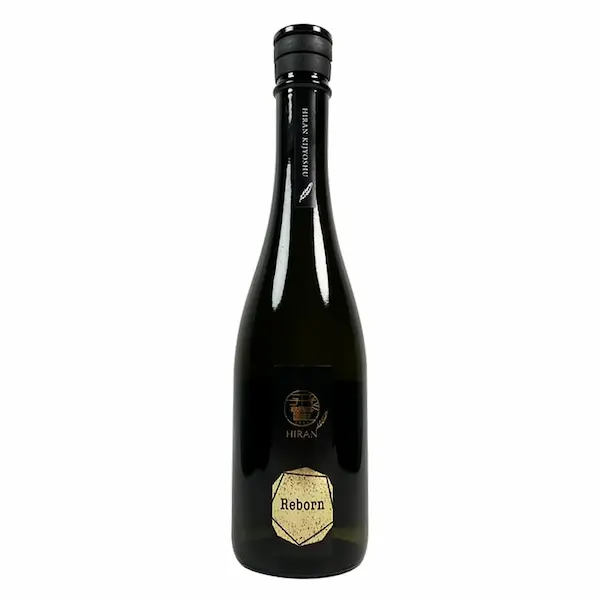
Brewery: Mori Shuzojo, Nagasaki Prefecture
| Specification | Details |
| Rice polishing ratio | 70% |
| Alcohol content | 14% |
| Sake Meter Value | Not disclosed |
| Acidity | Not disclosed |
HIRAN Reborn is produced by Mori Shuzojo in Hirado City, Nagasaki Prefecture.
This sake combines the traditional kimoto brewing method with the production technique used for kijoshu, a distinctive style of sake known for its rich sweetness.
In conventional sake brewing, water is used during the preparation of the main fermentation mash. In kijoshu production, some of this water is replaced with finished sake.
This method generally results in more residual sugar, giving kijoshu its characteristic sweetness and fuller body.
The name “Reborn” reflects the concept of using sake that has already been produced to create a new sake.
Because kijoshu often contains more residual sugar than conventional sake, it tends to have a higher specific gravity and may show a more negative SMV.
Although the exact SMV and acidity of HIRAN Reborn are not disclosed, its flavor clearly demonstrates the characteristics of a rich, sweet sake.
It offers a concentrated sweetness balanced by acidity associated with its kimoto brewing method.
Notes reminiscent of apricot and honey contribute to its distinctive sweet-and-sour character, while its smooth, slightly thick texture gives it a luxurious mouthfeel.
The balance between sweetness and acidity prevents the flavor from becoming one-dimensional.
With its smooth texture and lingering sweetness, HIRAN Reborn is particularly well suited as a dessert sake.
It also illustrates an important point: even without knowing the exact SMV or acidity, tasting can reveal how these elements interact to create a balanced and complex sake.
6. How to Pair Sake with Food Using SMV and Acidity
Understanding SMV and acidity not only helps us interpret sake labels but also provides useful guidance when pairing sake with food.
By considering whether a sake is generally sweet or dry, along with its acidity and body, we can begin to identify combinations that complement different ingredients and cooking styles.
For example, light and dry sake often pairs well with delicate flavors, while richer sake can complement more strongly seasoned dishes.
Similarly, sweetness and acidity can create interesting contrasts or harmonies with food.
The following four categories provide a practical starting point.
1. Positive SMV + Low Acidity: Light and Dry
Sake in this category generally has a smooth mouthfeel and a clean, refreshing finish.
Its relatively delicate character makes it well suited to dishes with subtle flavors, as it complements the ingredients without overpowering them.
Recommended food pairings:
- White fish sashimi and sushi
- Lightly grilled fish
- Tofu and edamame
- Tempura
When paired with white fish sashimi or sushi, the sake’s clean character allows the delicate flavors of the seafood to remain prominent.
It also complements simple ingredients such as tofu and edamame.
With tempura, the refreshing finish can help balance the richness of the fried batter, leaving the palate feeling clean.
2. Positive SMV + High Acidity: Rich and Dry
This style combines the crisp character associated with dry sake with greater richness and depth.
Its pronounced acidity and body make it suitable for strongly flavored dishes, particularly those seasoned with soy sauce, miso, or other savory ingredients.
Recommended food pairings:
- Yakitori with a sweet soy-based glaze
- Fish simmered in soy sauce
- Yakiniku (Japanese grilled meat)
- Buta no kakuni (braised pork belly)
When paired with yakitori or simmered fish, the sake’s richness complements the sweet-and-savory seasonings without being overwhelmed.
It also works well with fatty meats such as yakiniku and braised pork belly.
The sake’s acidity and crisp finish help balance the richness of the food, creating a more harmonious pairing.
3. Negative SMV + Low Acidity: Light and Sweet
Sake with a negative SMV and relatively low acidity generally has a gentle, rounded sweetness.
This style pairs particularly well with ingredients that have subtle natural sweetness, such as eggs, vegetables, and certain types of seafood.
Recommended food pairings:
- Chawanmushi (savory steamed egg custard)
- Dashimaki tamago (Japanese rolled omelet)
- Fresh cheese and fruit
- Lightly sweet-and-sour vegetables or seafood
When paired with chawanmushi or dashimaki tamago, the sake’s gentle sweetness complements the natural flavors of the eggs.
The soft texture of the sake also works well with the delicate mouthfeel of these dishes.
This style can also be enjoyable with foods containing mild acidity, such as lightly pickled vegetables or crab served with vinegar.
The combination creates a pleasant balance between sweetness and acidity.
4. Negative SMV + High Acidity: Rich and Sweet
Sake in this category combines noticeable sweetness with pronounced acidity.
The acidity helps balance the richness, making it suitable for strongly flavored dishes as well as foods containing both sweetness and tartness.
Recommended food pairings:
- Sweet-and-sour pork
- Glazed spare ribs
- Tomato-based pasta
- Caprese salad
- Rich cheeses and yogurt-based dishes
When paired with sweet-and-sour pork or spare ribs, the sake’s sweetness complements the rich seasoning, while its acidity helps refresh the palate.
Tomato-based dishes are another interesting option.
The natural acidity of tomatoes can harmonize with the acidity of the sake, while ingredients such as cheese add richness and umami.
These combinations demonstrate how sweetness and acidity can work together to create balanced food pairings.
Of course, these categories are general guidelines rather than strict rules.
The best pairing also depends on the sake’s aroma, texture, umami, serving temperature, and the specific ingredients and seasonings used in the dish.
Experimenting with different combinations is one of the most effective ways to understand how sake interacts with food.
Conclusion: Understanding Sake Through SMV and Acidity
Sake Meter Value and acidity are two useful measurements for understanding the characteristics of sake.
SMV provides an indication of the balance between sweetness and dryness, while acidity contributes to the sake’s structure, richness, and overall flavor.
However, neither measurement can fully describe how a sake will taste.
Rice varieties, polishing ratios, brewing methods, yeast strains, and many other factors also influence the final product.
By understanding how these elements interact, we can begin to appreciate sake from a more informed perspective.
Rather than simply classifying sake as sweet or dry, we can recognize the balance between its different components and consider how they contribute to its flavor.
This knowledge is particularly valuable when choosing sake and exploring food pairings.
At Kyoto Insider Sake Experience, our Certified Sake Specialists introduce these principles through guided tastings and food pairing in Kyoto’s historic Fushimi Sake District.
By comparing different sake styles side by side, guests can experience how sweetness, acidity, aroma, and brewing techniques influence flavor.
Understanding these differences can change not only how you choose sake, but also how you enjoy it.
Explore Our Kyoto Sake Tasting Experiences
Your Japan Trip Gets Better Once You Understand Sake
Start with Kyoto Insider Sake Experience in Fushimi.
Fushimi is Kyoto’s sake district — but simply visiting a bar or shop won’t help you understand which sake to choose or why it tastes the way it does.

At Kyoto Insider Sake Experience, you’ll join an expert-led sake tasting and food pairing session designed to help you taste with confidence. By comparing different styles side by side, you’ll clearly understand the differences in aroma, flavour, and structure — and discover what you truly enjoy.
This experience is the perfect introduction to sake at the beginning of your trip in Japan. Not just tasting sake, but learning how to choose it — anywhere, anytime.
Discover Japan’s real sake & food culture in Fushimi.
Written by Momoko, a sake tour guide
Qualifications: J.S.A. Sake Diploma
About me:
Sake Sommelier (Sake Diploma) from Osaka, Japan
My love of sake led me to experience sake brewing as a brewer. I also work as a guide for the Kyoto Insider Sake Experience to spread the charm of sake.